


Wire-free vs boundary-wire robotic lawn mowers: which suits your garden?
The short answer: boundary-wire mowers follow a physical cable and suit stable layouts; wire-free mowers use satellite, camera or LiDAR navigation to create virtual boundaries and suit gardens that change, but need a site that suits their navigation system. Neither is right for every property.
How boundary-wire mowers work
A boundary wire is a low-voltage cable laid around the edge of the lawn and around anything the mower should avoid. The mower detects the signal and stays inside it, and many models also use guide wires to find their way back to the charging station. It is an established, reliable approach. The trade-off is installation time and the occasional repair if the wire is cut, for example during garden work.
In our range, the Husqvarna Automower 310E NERA is a boundary-wire model; Husqvarna also offers an EPOS plug-in to convert compatible NERA models to wire-free operation.
How wire-free mowers work
Wire-free models define a virtual mowing area in an app instead of a buried cable. The technologies differ:
- RTK satellite positioning (for example Husqvarna EPOS and Segway Navimow's RTK systems) uses satellite signals corrected by a reference station or network for centimetre-level positioning.
- Vision uses cameras to recognise the lawn edge and obstacles, often combined with RTK.
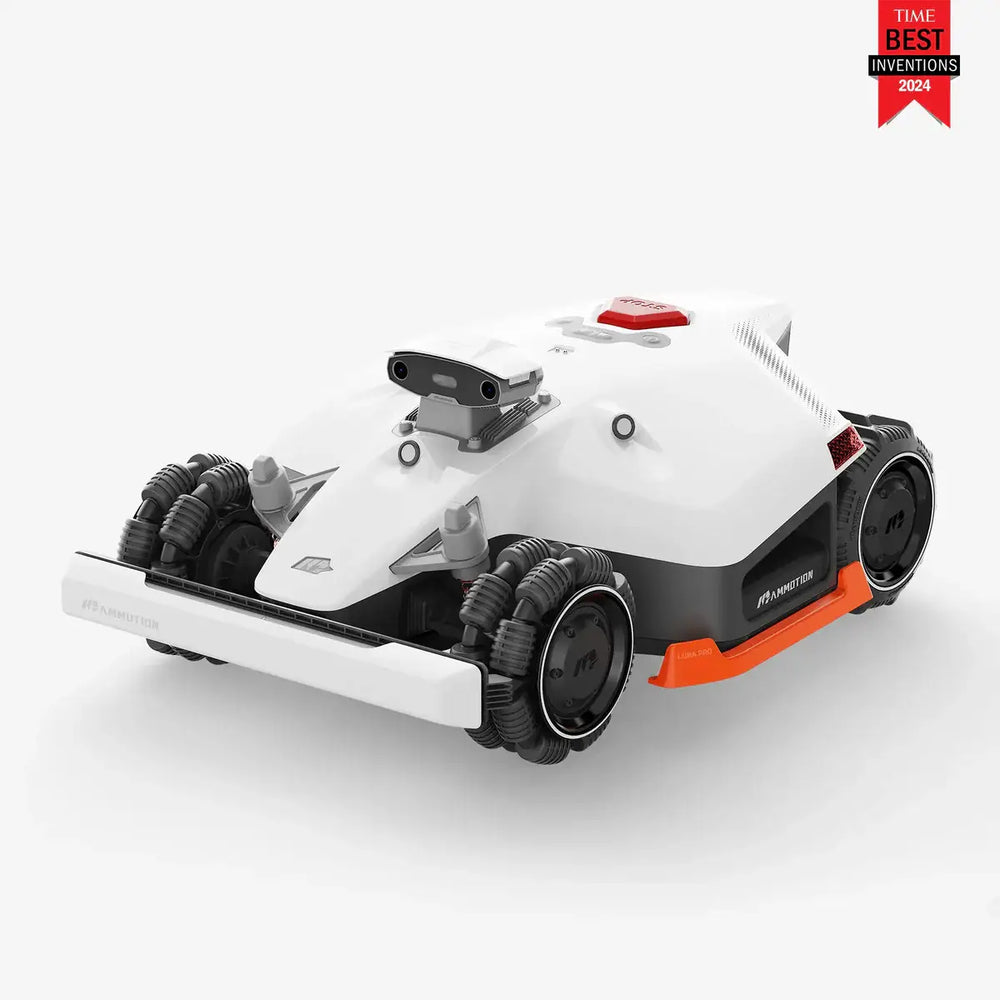
- LiDAR uses laser scanning to map surroundings, as on the Mammotion LUBA 3 and LUBA mini 2 and the Segway Navimow H2 series.
You still need to map the lawn, and satellite-based systems need a reasonable view of the sky.
Which is easier to install?
Wire-free systems avoid laying cable, but some need a reference station mounted with a clear view of the sky, or a mobile data connection. Boundary-wire models need the cable laid and pegged or buried. Compare the actual installation steps for the exact model rather than assuming one type is always quicker.
What about trees, buildings and narrow passages?
Tall trees, buildings and covered areas can weaken satellite signals, so purely RTK-based mowers can struggle under heavy canopy or close to walls. Models that combine RTK with vision or LiDAR are designed to cope better in these spots. Narrow passages and separate lawns also need checking against each model's minimum passage width and multi-zone support.
What to compare before buying
Start with your lawn area, steepest slope and garden layout. Then compare navigation type, included hardware (reference station, antenna, 4G module), multi-zone support and the manufacturer's site requirements. The Mower Finder can filter for wire-free models only, and Compare lists boundary type and navigation for each model side by side.